Why I’m striking #2: Space, time and mental health

An interesting day yesterday, watching the strike get underway on media and social media. I spent most of the day out of the city, volunteering with the Sheffield & Rotherham Wildlife Trust doing streamflow monitoring on sites that I set up as part of the science input to their Working with Water project (part of the Sheffield Lakeland Landscape Partnership) in the Upper Don catchment.

As I was trudging along the path from the road to our level gauge on a small stream above Langsett Reservoir, flicking raindrops off my hood, I was trying to decide whether it felt different to be doing this for free rather than for work. The short answer – no. The obvious follow-up – why not?

Clearly, I was wearing the exact same clothes, using the exact same kit, following the exact same routine as I would if I was doing this as work under my consultancy contract. One constantly-amazing aspect of my job as a physical geography academic is the opportunities it gives me to spend time in the field, both for research and teaching. Moreover, the relative flexibility and autonomy to create those opportunities both within and outside of the timetable. These are among the very best bits of a job that, overall, I love to bits, and they are very good for mental health.

But is there a problem here? In common with other professions, most academics I know see their work as a vocation and an identity. We would, I suspect, be doing, reading and thinking much the same things regardless of whether we are being paid or not. There are, of course certain aspects of academic life which are identifiably ‘the job’ – the admin, the meetings, the teaching, the tutorials, and so on – but in many areas the boundaries between these and our autonomous intellectual lives are blurred to the extent that when I’m reading a paper on the geochemistry of tholeiitic basalts from the Reykjanes peninsula in bed at eleven at night it is impossible to clearly define whether it is certifiable teaching prep or just, well, certifiable. Either way, to me, it counts as fun.

Hence, the social media threads in which academics outdo each other with claims to work 100 hours a week. I’m not having a go here – many of us do work much longer than our contracted hours, both in the office and then when we get home. And on trains, in cars, on planes, in airports, hotel rooms, on ferries, in cafes and on park benches, up mountains, on beaches. Between your brain, your phone and a laptop, work can follow you anywhere. The crucial considerations here are expectations, and control. Immersing yourself in a subject is one of the most pleasurable pursuits I know, until you realise you can’t come up for air. Or worse, that someone expects you to stay under until you come up with something worth their while.

Worse still, that as well as finding your own way back to the surface, you are responsible for the safety and success of, literally, hundreds of completely inexperienced divers most of whom have not read any of the manuals and some of whom have very little idea of where they are or how they got there.

I’ll stop the analogy before I mangle it completely, but this is the crux of what is emerging as a mental health crisis in the university sector. What was – and is still espoused as – ‘academic freedom’ to explore, discourse on and propagate a discipline from a unique point of experience and expertise is being replaced by a poorly defined, vaguely punitive delegation of responsibility to ‘perform’; not just to exist as an academic, not just to be the best that you can be, but to pursue someone else’s conception of ‘excellence’.

What has any of this to do with what we’re striking for? For me, this is at the heart of the issues over workload intensification, job insecurity and inequality at both local and national levels. It is not just about the detail of AWPs – whether we get 2.5 or 3 minutes extra per student per assessment, or whatever – although that is a crucial manifestation of another issue I want to pick up on later this week. The point is that in the marketisation of both research and teaching in Higher Education, universities at large have neglected the well-being of the very assets they rely on to deliver both – their staff.

If you’ve been watching ‘His Dark Materials’ on the BBC recently, you’ll be familiar with the concept of ‘scholastic sanctuary’. In Lyra’s world, it has a very real legal and constitutional definition, but in the real world it underpins the concept of the academy too, as a refuge and as a crucible for open, broad and deep thinking; as an institution which exists, charitably, to promote and preserve learning as an act and as an objective. Academic staff, and others committed to the university sector in specialist technical and professional roles, are being told that scholastic sanctuary is dead, an out-of-date concept for a bygone age, unfit for the challenges of the 21st century.

Whether we are conscious of it or not, that cuts deep into the ideal of academic freedom, into the love of a subject, and of teaching it, simply because of what it is. I believe that is the deep trauma that underpins much of the mental health crisis in academia. And I believe that if university management are willing to destroy academic freedom, to remove scholastic sanctuary, then it is the very least of their responsibility to replace it with something as valuable and as nourishing; to understand the scale of the trauma and to protect, and support, and inspire their people through the change.

This is something universities have manifestly failed to do. Whose fault that is, is difficult to define and probably a reflection of much larger political forces as well as failings of policy, practice and empathy within the sector. As I said yesterday, the strike is about detail – important, but limited symptoms of something much more complex. Whether it is a battle in an existential war, or a painful step on a necessary journey, is not yet clear.
Why I’m striking #1: the point of exploration

Well, it is 6.30 am on a Monday morning. Kitchen is cleaned down, kids’ packed lunches are made, and Lizzie has a cup of tea. So far, so everyday. About now I would usually be checking emails for the first time this week, looking at my timetable and wondering whether I’m going to be able to find any space to progress research work, or thinking through how I’m going to deliver whatever classes or lectures I’ve got on.

But I’m not. For the first time in my career, somehow, I’m part of a union dispute, and I’m on strike.

I’ve been through a huge range of emotions in the past week, as the 8 day strike approached. Something like the stages of grief. I’ve been frustrated, angry, anxious. I’ve spent evenings checking the rules and regulations and worrying about the impacts on my colleagues and local managers (who are also my colleagues). I’ve been sad, really sad, and then by turns euphoric. It feels good to be finally taking a stand against things that I’ve been whingeing about in the office for months, or years. But it also strikes deep against my professional instincts towards the education of my students, my loyalty to my institution – which is really there – and my responsibilities to my team.

The practical reason I’m on strike is because my union has asked me to be. They’ve been negotiating with the universities on a range of subjects which benefit my pay and conditions, have failed to make progress, have asked us to vote on what to do, and been given a mandate to call us out of work. That’s the deal and so here I am. But of course that’s not a personal justification, and so I’m using this time to explore what underpins this dispute, how I can make sense of my place in academia and what will happen when this strike is over and I’m back at work.

My first point has to be that it is not a personal grievance about my pay, or a cry for help about my personal conditions. I am (and I assume I will continue to be!) a senior lecturer, full-time, permanent contract, just entering what I guess is best termed mid-career. I’m well-off; despite the headlines that the strike is about falling pay and punitive pensions conditions, I’m not feeling that. I earn more than I did this time last year, just through annual increments; pensions are a dark art to me.

Workplace conditions are a slightly different matter. I’ll think and write about this in more detail over the course of the week. My time in my current job – just under 3 years – has seen massive and constant change in the systems and structures of the university. Faculty rebranding, reorganisations, large-scale restructuring. Consultant-driven wholesale change in the professional services structures, and most recently technical services, leading not only to the loss of experienced, specialist support staff but the seemingly-arbitrary relocation of staff to new roles and new offices with which they are not familiar. New curriculum structures have been announced top-down and rolled out on timescales completely at odds with long-established cycles of academic operation, quality review and implementation of change. There is a sense of a ‘hostile environment’ on spending anything to support our jobs.

The impacts of these changes on my colleagues has been stark. Course and modules leaders no longer know who to go to for administrative or technical support – or don’t have confidence they will get it even if they do. Local academic managers trying to implement these changes alongside their own workload, and dealing with the grievances of those beside them at the coalface, are visibly stressed, even distressed. Communications within the team – never a strong point – become even more strained. Everything is more intense; everything is more uncertain; everything seems more of a struggle.

Is this productive? Is this the feeling of an agile economic machine easing into top gear? Where, in any of this, is the education of our students? Where is the intelligent, considered, deliberate pursuit of knowledge as a fundamental social good? Where is the organisation of the University in service of these goals?

I’m striking because my union is in dispute on specific issues, and has asked me to strike. But with eight days now that are suddenly entirely my own, free time, I’ve realised that I’m only just beginning to explore the real urgent need to take a stand.

On the road

It is night and the road is bending and fading

before me, blurring into

sharp reality at the nearside kerb, the threat

of a sudden journey’s end

perpetually startling.


The radio fell silent miles ago with the fall of the

leaves wracking in the slip-

streamed darkness. Only the blown-back bubble-glow

of headlamps and the

constellations of the dash betray your form.


We are all falling somehow you once said; through

our lives, and into sleep

together here and in my charge, falling forward

soundlessly, as in a low orbit,

towards the dawn.

Bat Music

BAT MUSIC

October, dusk and

brushing through leaf-litter

we talked of poets, dead

and living. The children


ran ahead, light feet

splashing dark puddles

and radiating sound

along the sharp bright beams


of torches. Where do

the poems come from, some-

one asked. You smiled. They’re

out here, waiting. Listen:


there, above us all,

were bats, dancing like words

uncaptured, nebulous

and flickering as dreams.


Copyright Jon Bridge 2019.


Exciting new AHRC-funded project – HydroSpheres

I’m excited to be working with Dr Niamh Downing (Humanities, Sheffield Hallam University) on a new research network grant funded by the Arts and Humanities Research Council as part of the cross-Council Landscape Decision-Making programme.

This will be quite a departure for me from my past research which has focused very much on the science-y approach to water resources. We’ll be working with artists and writers, as well as researchers and non-academic practitioners and stakeholders involved in decision-making around management of the ‘hydrological landscape’ in the Sheffield region. We want to unpick the hidden motivations, conflicts and preconceptions which influence decision-making quite as much as ‘rational’ data or policy drivers.

This is also a great opportunity to develop my relationship with Sheffield Lakeland Landscape Partnership and the Sheffield & Rotherham Wildlife Trust, who are our main partners on the grant.

Looking forward to kicking off in January 2020!

New article on The Conversation!

Oroville dam danger shows how Trump could win big on infrastructure

Jonathan Bridge, Sheffield Hallam University

Disaster was narrowly averted after America’s tallest dam threatened to release a deluge of water over thousands of homes on February 12. Dramatic scenes of water cascading from the Oroville dam emerged after a hole the size of a football field appeared in the spillway floor, allowing water to rip through its foundations and compromise the whole structure. Authorities ordered 180,000 people to evacuate while the water level was lowered to relieve pressure on the damaged spillway. But 48 hours later, the immediate danger had passed and residents were allowed to return home.

This near catastrophe is just the latest symptom of the chronic ill-health of America’s civil infrastructure, which has suffered from decades of under-investment and neglect. But the Oroville dam crisis could provide an unexpected opportunity for the new Trump administration to take on both problems – and win.

Winning is important to the US president, Donald Trump. This is not in dispute. He has built his name, his fame and his entire presidential campaign on being seen to be a winner. In office, he has been quick to reject situations where there is no easy win in sight: from his opposition to the environmental lobby, to his dislike of multilateral trade deals and his “shut up shop” attitude on migration.

But when it comes to infrastructure, the win is clear to see: stuff is broken, stuff can be fixed by good, honest blue-collar workers driving proper US-made machines. These things can be paid for using money – and money is what Trump knows about. New roads, new jobs, a New Deal even – these all look like wins for a relentlessly ambitious president.

What’s the damage?

But renewing the nation’s failing infrastructure is not a simple process, as successive White House administrations have found. Up to US$1 trillion is required to repair or replace ageing dams, bridges, highways and all the other components that support modern civilisation. Where to source the money has been a subject of political wrangling for decades.

Arguments between state and federal administrations, fuelled by political in-fighting and lobbyists – including environmentalists who are opposed to big infrastructure on principle – have all contributed to the stasis. But with a new strategy, Trump might just be able to score a big win where other presidents have lost out.

For water infrastructure, such as Oroville dam, perhaps the most obvious part of the problem is the weather. After five years of extreme drought, this winter has brought record rainfalls. Just prior to the crisis, the Oroville reservoir and others like it were at more than 150% of their normal capacity.

Under these conditions, every storm becomes a challenge for water resource engineers. But what has this got to do with Trump’s infrastructure promise? Year-on-year variations in seasonal weather are highly unpredictable. But in the longer term, atmospheric rivers (a key factor in Californian climate) and similar extreme weather events are robustly predicted to increase in frequency as the global climate warms. The strong balance of scientific evidence and opinion suggests that greenhouse gas emitters worldwide are at least partially responsible: particularly in the US and China, which together generate a third of world emissions

The denier’s dilemma

This presents Trump the climate change denier with a dilemma. To get the win on infrastructure, he needs money. To get the money in a reasonable time frame, he will need corporate investors who are prepared to cut through the political deadlock. But investors require incentives to channel funds into long-term public works, for which Trump will claim the bulk of the credit. And market economics suggests that if there was any money in it for them, this would already be happening.

The Oroville dam, though, demonstrates that some of the largest imminent threats to infrastructure will increase through climate change. If Trump could take an executive decision to shift his position on that – surely not hard for someone who deals so readily in “alternative facts” – then a pathway to the win could open up.

Keen for a win.
Gage Skidmore/Flickr, CC BY-SA

Apportioning blame for carbon emissions could bolster his case for tariffs and other sanctions on Chinese imports. A similar economic stick for domestic polluters would be less palatable, but the money raised could be used to provide corporations with financial incentives to invest in maintaining infrastructure, expanding renewables and adopting green, energy-efficient technology. All these projects promise long-term gains for US businesses and jobs, if only the initial inertia could be overcome. Carbon reduction tariffs, linked specifically to infrastructure renewal incentives, could provide that vital momentum.

Such ideas have been around for decades: environmental thinkers including Paul Hawken and Amory Lovins espouse the notion of “natural capitalism” – a market-driven economics which centres on the value of natural resources. The Oroville dam provides compelling evidence of the hard economic costs of inaction on infrastructure.

Accepting man-made climate change could provide Trump with a chance to deliver on one of his major campaign promises, change the face of capitalism and perhaps even save the world along the way. Doesn’t that look like a win?

The Conversation

Jonathan Bridge, Senior Lecturer in Physical Geography, Sheffield Hallam University

This article was originally published on The Conversation. Read the original article.

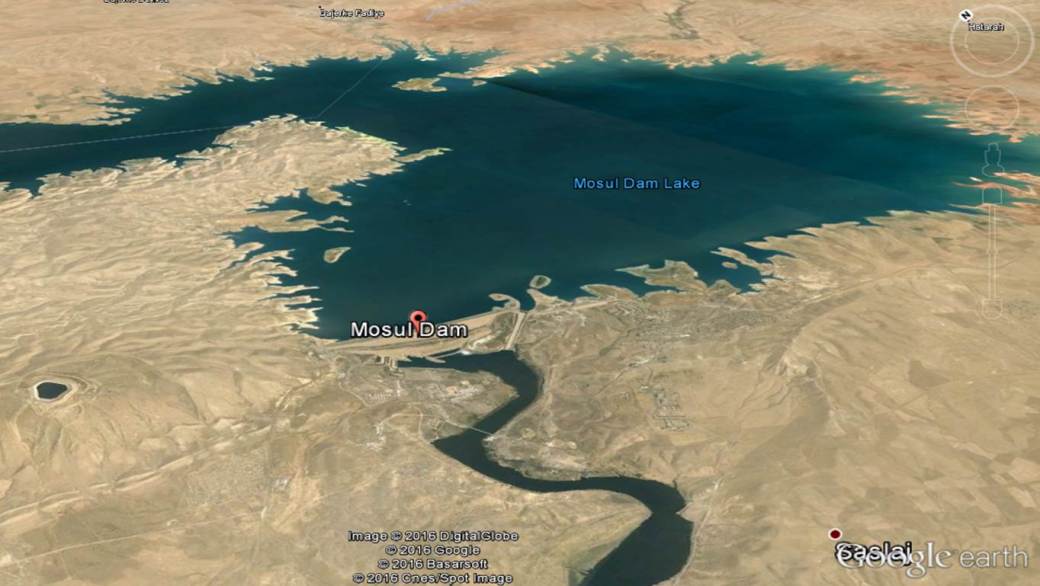
Danger at Mosul Dam – interview on Austrian radio

Following my 2014 article on The Conversation which looked at the risks around Mosul Dam, in Iraq, I was interviewed today for a piece broadcast on Austrian radio FM4. You can hear the brief conversation with the presenter, Steve Crilley, here. Wind back a little to catch the intro.

FM4 is an alternative mainstream radio station which broadcasts all over Austria and Southern Germany. It was great to be asked to comment on the increasingly dangerous situation at Mosul.

mosul

My colleague Dr Ziad Abdeldayem and myself are currently working on a reanalysis of topographic datasets for the upper Tigris around Mosul in an attempt to provide better predictions of flood wave heights and flood extents should the dam collapse (for a nice article on why this might happen, see here). We will present this at an international workshop on the engineering crisis at Mosul, to be held next month in Rome.

Meantime, we are keeping our fingers crossed that the dam holds firm…